
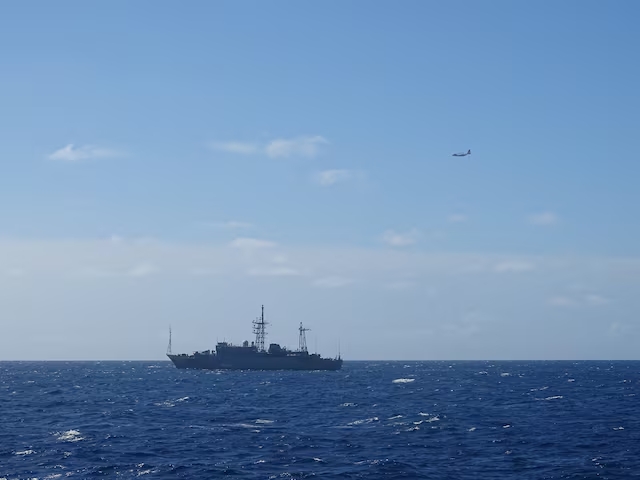
The U.S. Coast Guard detected and monitored a Russian Navy intelligence vessel operating about 15 nautical miles south of Oʻahu on October 29, part of a routine but closely coordinated surveillance effort involving U.S. defense forces. The ship was identified as the Kareliya, a Vishnya-class auxiliary general intelligence vessel, known for signals-intelligence gathering.
Responding to the vessel, the Coast Guard dispatched a HC-130 Hercules aircraft from Air Station Barbers Point and the Cutter William Hart to conduct a “safe and professional” overflight and surface transit near the Kareliya. Their mission: observe the Russian ship’s activity and ensure the security of U.S. maritime operations in the region. “Working in concert with partners and allies, our crews monitor and respond to foreign military vessel activity near our territorial waters to protect our maritime borders and defend our sovereign interests,” said Capt. Matthew Chong, Chief of Response for Coast Guard District 14 (Oceania).
The Coast Guard stressed that their actions comply with international law: under customary maritime law, foreign military ships may operate outside another nation’s territorial waters, which for the U.S. extend up to 12 nautical miles from shore.
While the Kareliya remained outside the territorial sea, the proximity of a Russian intelligence vessel so close to Hawaiian shores underscores enduring security concerns. The Vishnya-class ships like the Kareliya are designed for SIGINT (signals intelligence) and have a history of operating near strategic U.S. Pacific sites. According to defense analysts its presence near Hawaii, home to key U.S. military assets including the Pacific Fleet could be aimed at gathering intelligence on U.S. naval activity.
The Coast Guard’s operations off Oʻahu are carried out in coordination with U.S. Indo-Pacific Command and other interagency partners, reflecting a broader strategy to monitor military activity in the region, including around U.S. territories like Guam and American Samoa.
Although the Russian Embassy in Washington had not yet responded to requests for comment, the U.S. has not framed the incident as an aggressive confrontation. Instead, Coast Guard officials describe the monitoring as a standard procedure, part of their ongoing role in maintaining maritime domain awareness and defending U.S. interests in the Pacific.
For local residents, the appearance of a Russian intelligence ship near Oʻahu may raise unease, but authorities emphasize that no laws were broken. The Kareliya’s mission and behavior so far are consistent with long-standing patterns of Russian naval presence in the Pacific though experts warn that such deployments will continue to test the U.S. ability to balance deterrence with diplomacy.