
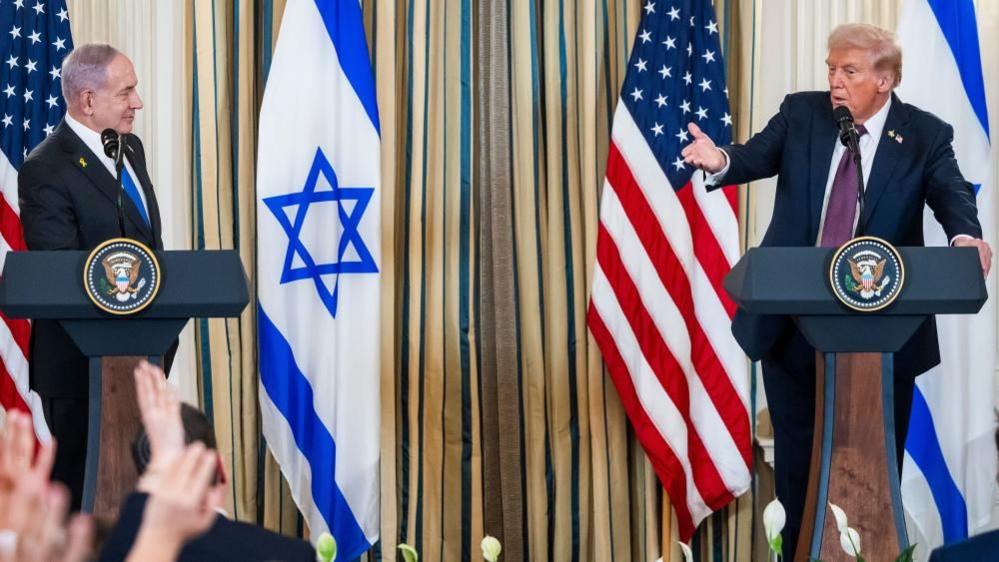
In late September 2025, former U.S. President Donald Trump unveiled what he called a “21-point plan” aimed at ending the war in Gaza, resolving the hostage crisis, and projecting a pathway toward a restructured Gaza. The announcement has stimulated intense debate, conditional agreements, and uncertainty.
Summary of Trump’s 21-Point Gaza Plan:
Following is the detailed summary of the proposal, provided by the White house:
1.Demilitarized, Terror-Free Gaza
Gaza is to be transformed into a “de-radicalized, terror-free zone” that poses no threat to Israel or neighbouring countries.
2. Rebuilding Gaza for Its People
The plan envisions large-scale redevelopment aimed at improving living standards for Gazans, emphasizing that the civilian population has suffered enough.
3. Immediate Ceasefire upon Acceptance
If both Israel and Hamas accept the proposal, hostilities will stop immediately. Israeli forces will pull back to an agreed line, and all combat operations including airstrikes and artillery fire will pause while preparations for a hostage release are made.
4. Hostage Release within 72 Hours
Within 72 hours of Israel’s public acceptance, all hostages held in Gaza both living and deceased must be returned.
5. Prisoner Exchange and Remains Return
After hostages are freed, Israel will release 250 prisoners serving life sentences and 1,700 Gazans detained after October 7, 2023, including all women and children. For each Israeli hostage whose remains are returned, Israel will release the remains of 15 Gazans.
6. Conditional Amnesty for Hamas Members
Hamas members who agree to peaceful coexistence and surrender their weapons will receive amnesty. Those unwilling to comply will be granted safe passage to third countries willing to receive them.
7. Immediate Humanitarian Aid
Upon acceptance, “full aid” including food, water, fuel, and reconstruction materials will enter Gaza. The plan references the January 19 2025 humanitarian accord as a baseline for aid levels, covering infrastructure repair, hospital rehabilitation, bakery reopening, rubble removal, and road clearance.
8. Neutral Distribution of Aid
Aid delivery will be managed by the United Nations, the Red Crescent, and other impartial international agencies, free from interference by either Israel or Hamas. The Rafah crossing will reopen under mechanisms established in the January 2025 aid agreement.
9. Transitional Technocratic Governance
A temporary Palestinian technocratic committee composed of qualified Gazans and international experts will manage day-to-day governance and municipal services. Oversight will be provided by a new international body, the Board of Peace, chaired by Donald Trump and including other leaders such as former U.K. Prime Minister Tony Blair. This board will supervise Gaza’s redevelopment and guide governance reforms until the Palestinian Authority (PA) completes institutional reforms and can retake control.
10. Economic Development Framework
A Trump Economic Development Plan will bring together experts who have helped design successful “modern miracle cities” in the Middle East to attract investment, create jobs, and integrate Gaza into regional economies.
11. Special Economic Zone
A designated special economic zone will offer favourable trade terms and tariffs to encourage investment and growth.
12. Freedom of Movement without Displacement
No one will be forced to leave Gaza. Those who wish to emigrate or return will be free to do so, but residents will be encouraged to remain and participate in rebuilding.
13. Exclusion of Hamas from Governance & Demilitarization
Hamas and all militant factions will have no role ,direct or indirect in Gaza’s future governance. All tunnels, weapons facilities, and military infrastructure will be destroyed under the supervision of independent monitors. A structured disarmament, weapons buy back, and reintegration program will be funded internationally and verified by those monitors. The new Gaza will commit to peaceful coexistence and economic development.
14. Regional Guarantees of Compliance
Neighbouring Arab partners will guarantee that Hamas and other factions abide by the agreement and ensure Gaza does not again threaten its neighbours.
15. International Stabilization Force (ISF)
The U.S. will lead efforts with Arab and international partners to deploy a temporary International Stabilization Force (ISF) in Gaza. This force will train and assist vetted Palestinian police, coordinate security with Egypt and Jordan, secure border areas, prevent weapons smuggling, and facilitate safe delivery of goods.
16. No Israeli Occupation or Annexation
Israel will not annex Gaza. As the ISF achieves stability, the Israel Defense Forces (IDF) will withdraw in stages tied to progress on demilitarization, under agreements between Israel, the ISF, the U.S., and regional guarantors. A limited Israeli security perimeter may remain until Gaza is fully secure.
17. Partial Implementation if Hamas Rejects
If Hamas delays or refuses the plan, its provisions including humanitarian aid and governance measures will still proceed in areas already cleared and handed over by the IDF to the ISF.
18. Interfaith Dialogue for Peace
The plan calls for interfaith initiatives to promote tolerance, change hostile narratives, and build trust between Palestinians and Israelis.
19. Pathway to Palestinian Self-Determination
As Gaza’s reconstruction progresses and the PA completes its reform program, conditions will emerge for a credible pathway toward Palestinian self-determination and eventual statehood, recognized as the legitimate aspiration of the Palestinian people.
20. U.S.-Led Political Dialogue
The U.S. will facilitate renewed talks between Israel and the Palestinians to agree on a political horizon for lasting peace and coexistence.
21. Implicit Oversight Mechanism
Though not always numbered separately, some versions add a final provision establishing international oversight to monitor compliance and resolve disputes effectively the enforcement framework of the plan.
Mixed Responses and Continued Fighting After Trump’s Gaza Plan:
Since former U.S. President Donald Trump announced his 21-point Gaza plan in late September 2025, reactions from all sides have been mixed and uneven in practice. As of early October 2025, diplomatic channels remain active, but implementation of the plan’s core provisions particularly Gaza’s demilitarization and the transition to technocratic governance has yet to begin.
Though Hamas publicly welcomed several elements of the proposal including the ceasefire, large scale prisoner exchange, and humanitarian aid surge and even agreed in principle to release all Israeli hostages, alive or deceased. However, it stopped short of accepting the plan’s core conditions on demilitarization and its exclusion from Gaza’s future governance, insisting that these issues require further negotiation.
Israel, on the other hand, formally endorsed Trump’s plan and announced a limited pause in its Gaza City operations to prepare for the “phase one” hostage release and withdrawal process, but continued airstrikes elsewhere in the Strip, citing ongoing militant threats.
U.S. officials, working with Egypt and Qatar, have been mediating between the parties to implement the plan’s initial steps especially the ceasefire and humanitarian access while Trump’s team began outlining the proposed international “Board of Peace” and stabilization force. Yet despite the diplomatic activity, violence on the ground has persisted, civilian casualties continue to mount, and the political gap over Gaza’s demilitarization and governance remains unresolved.