
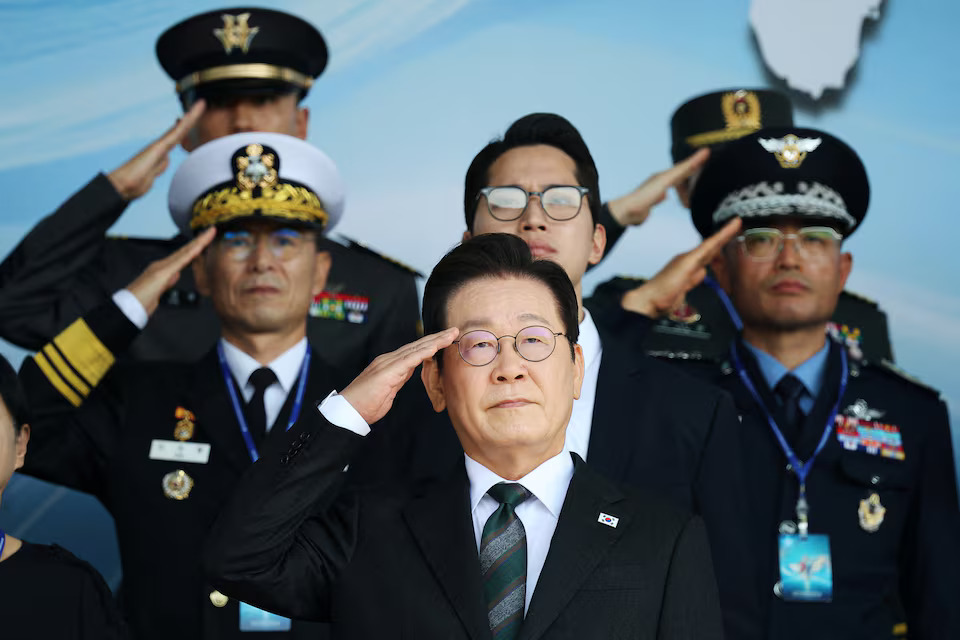
South Korean President Lee Jae‑myung declared that his nation is aiming to rank among the world’s top four defence powers by 2030, signalling a major shift in military-industrial policy and investment strategy.
Speaking at the opening of the Seoul International Aerospace & Defense Exhibition (ADEX) 2025, South Korea’s largest-ever arms fair, Lee said the government would allocate a “larger-than-expected budget” to defence and aerospace research, with a strong emphasis on achieving technological sovereignty and expanding exports of advanced weaponry.
“At this moment, becoming one of the top four powerhouses in the defence industry is by no means an impossible dream,” Lee asserted. He added that his administration will focus on developing core technologies, components and materials including specialised semiconductors that are essential for modern military systems.
South Korea currently holds the 10th-place ranking in global arms sales, according to data from the Stockholm International Peace Research Institute (SIPRI). To move up the ladder, the government plans to accelerate arms exports, especially of unmanned and artificial intelligence-enhanced systems showcased at ADEX, including suicide drones, automated howitzers and other advanced platforms.
Lee also highlighted a new “fast-track” industrial programme designed to let private enterprises develop and supply advanced weapons systems with fewer regulatory obstacles. The aim is to build a broader defence ecosystem that allows small and medium-sized firms and start-ups to participate, not just the major defence contractors. This, he said, would support economic growth while strengthening national security.
The push further underlines Seoul’s intent to reduce reliance on foreign suppliers and enhance self-reliance in defence. Lee described this as establishing “technological sovereignty” and pledged to share not just weapon systems but also underlying know-how with overseas partners. “We will secure the technologies, parts and materials that must be independent,” he said.
Industry experts note that South Korea’s defence export momentum has picked up in recent years, driven by large deals and increasing global demand. The nation is positioning itself as a supplier of choice for countries seeking modern capabilities paired with competitive pricing and flexible technology transfer.
However, achieving top-four status by 2030 will not be without challenges. Analysts point out that South Korea needs to maintain strong demand, navigate international arms-control regimes, and scale up investment in high-end technologies all while managing workforce issues and balancing geopolitical pressures.
By setting this ambitious target, South Korea is signalling that the defence sector will play a much more prominent role in its economy and foreign-policy strategy moving ahead.