
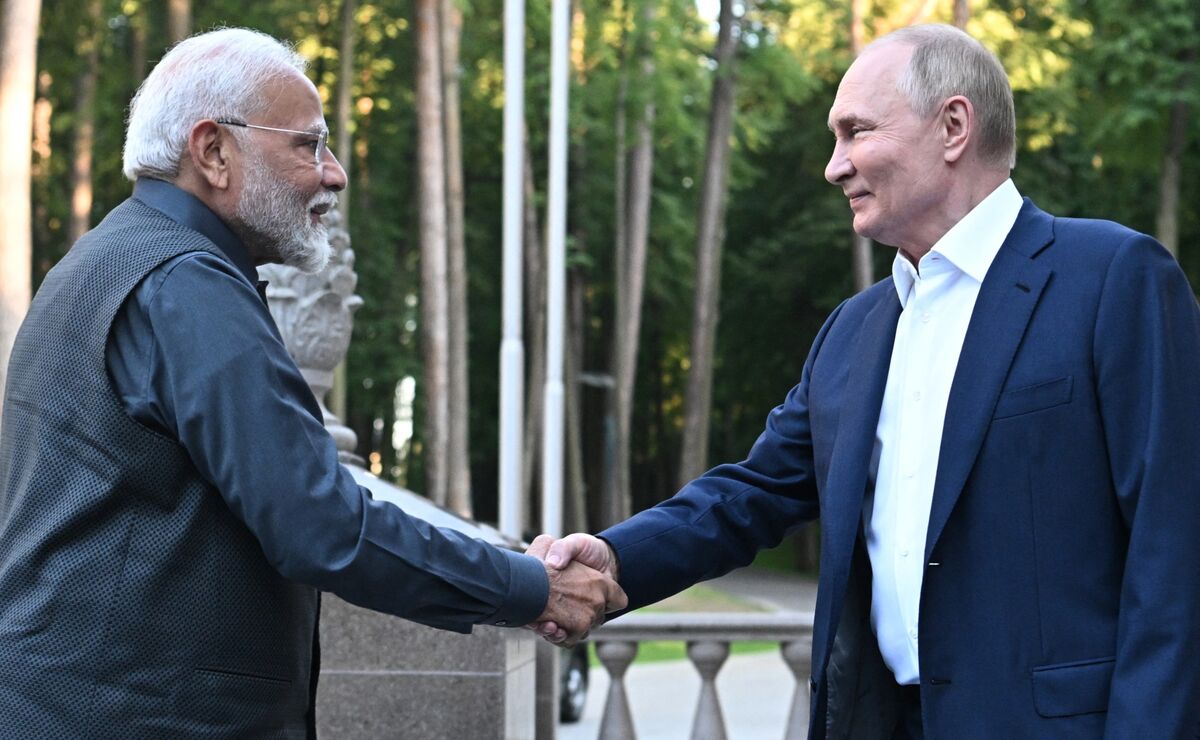
Russian President Vladimir Putin’s visit to India on December 5–6, 2025, is a significant diplomatic milestone for both countries. This marks his first visit to India since the outbreak of the Ukraine war, and it coincides with India’s increasingly pivotal role in supporting Russia amidst Western sanctions. The 23rd Indo-Russian Annual Summit is poised to enhance cooperation across several key sectors: defense, trade, energy, and security. As a result, India’s relationship with Russia has come under the international spotlight, raising questions about the nation’s alignment with a globally sanctioned power and its approach to the evolving global order.
Indian Dual Diplomacy
India’s diplomatic stance towards Russia has been characterized by a profound duality. Officially, India claims neutrality regarding the Ukraine conflict, calling for peace and dialogue. However, in practice, India has provided Russia with significant diplomatic cover. India has repeatedly abstained from key United Nations resolutions condemning Russia’s actions in Ukraine, instead positioning itself as a neutral observer. This abstention, however, is seen by many as an implicit endorsement of Russia’s actions. In essence, India’s diplomatic strategy is less about neutrality and more about opportunistic alignment with Russia.
India’s political cover for Russia can be seen as an attempt to balance its interests between the West and Moscow. India has capitalized on the strained position of Russia, securing discounted oil, weapons, and advanced technologies that have been largely inaccessible due to the sanctions imposed on Russia. These discounted deals have not only allowed India to advance its own defense and energy interests but also serve to undermine the Western sanctions regime. By strengthening its economic and military ties with Russia, India has, in effect, prolonged the conflict in Ukraine, making it a key enabler of Russia’s war efforts.
India’s claims of “strategic autonomy” also come under scrutiny. While India’s foreign policy framework emphasizes its independence in decision-making, its growing dependency on Russia undermines the credibility of this rhetoric. The 68–70% of Indian military imports that come from Russia showcase the extent of this dependence, contradicting India’s claims of diversification. Moreover, this dependency enables Russia to leverage India’s foreign policy posture, using it as a tool to challenge U.S. and EU sanctions regimes, further destabilizing global security and economic structures.
Moreover, India’s purchases of Russian oil have surged, with imports increasing by nearly 600% since 2022. Furthermore, India’s extensive military imports, including systems like the S-400 Triumf missile defense system, bolster Russia’s defense capabilities. These deals illustrate India’s complicity in Russia’s war machine, despite public claims of neutrality.
Inconsistencies In Foreign Policy
Prime Minister Narendra Modi’s leadership on the global stage has been marred by inconsistencies in his foreign policy approach. His inability to engage in high-level diplomacy with U.S. President Joe Biden while rolling out the red carpet for Vladimir Putin reveals a deep insecurity in his approach to international relations. Modi’s hesitation to meet with Biden, coupled with India’s growing military and economic ties with Russia, signals a departure from India’s traditional non-alignment posture.
India’s foreign policy actions also expose the country’s contradictory stance on the war in Ukraine. On one hand, India funds Russia’s war efforts through massive oil imports; on the other hand, it simultaneously provides Ukraine with military aid, including explosive compounds worth $1.4 million. This duplicitous conduct only serves to confuse India’s allies and portray it as a leader struggling to balance competing interests.
India’s information operations further exacerbate the situation. Rather than address the growing diplomatic isolation, India’s government has resorted to using Cabinet ministers to issue blunt statements defending its Russia ties. These actions not only undermine India’s credibility but also reflect the country’s failure to chart a consistent, principled foreign policy. The Modi administration’s failure to act decisively in the face of increasing international pressure highlights the disarray within India’s leadership, leading to a weakening of its position in global diplomacy.
Military Complicity
India’s deep military dependence on Russia is another facet of its complicity in Russia’s war efforts. Since the beginning of the Cold War, Russia has been India’s primary defense supplier, with an estimated $80 billion worth of military exports to India since 1947. As of 2025, Russia remains the source of 68–70% of India’s military imports, including advanced weaponry and defense systems such as the Su-30MKI fighter jets, T-90 and T-72 tanks, and the S-400 missile defense system.
This continued reliance on Russian military hardware leaves India vulnerable to the shortcomings of Russian technology, which often lags behind Western advancements. For instance, India has turned down offers for more advanced fighter jets, such as the U.S. F-35, in favor of Russian systems that are not as technologically advanced. Furthermore, India’s procurement of weapons like the S-500 missile system, which is heavily used in the ongoing Ukraine conflict, has raised concerns about India’s active role in supporting Russia’s military campaign.
Read Also:Trump to Impose Sanctions on Russia—Demands Support from NATO
In addition to these transactions, joint defense projects like BrahMos missiles and the production of AK-203 rifles further bind India to Russia, making it an integral part of Moscow’s military-industrial complex. The continued supply of dual-use technologies, including UAVs, missile components, and communications systems, has enhanced Russia’s war capacity, allowing it to circumvent Western sanctions.
Economic Ties
India’s growing economic dependence on Russia further complicates its diplomatic relations with the West. In the fiscal year 2024–25, India’s bilateral trade with Russia reached a record $68.7 billion. Of this, $63.8 billion came from imports, largely oil, coal, fertilizers, and defense-related goods. India’s export of only $4.9 billion to Russia creates a massive trade imbalance, one that further deepens India’s reliance on Russia.
India’s role as Russia’s largest wartime energy customer is particularly concerning. Since 2022, India has increased its crude oil imports from Russia by nearly 600%, consuming 38% of Russia’s total oil exports. This financial lifeline directly supports Russia’s war machine, allowing it to continue its military operations in Ukraine despite international sanctions.
The growing trade between India and Russia has not gone unnoticed by the U.S. and EU, who have criticized India for enabling Russia’s actions. U.S. officials have accused India of destabilizing the global order by providing Russia with crucial economic and military support, while the EU has condemned India’s participation in joint military exercises with Russia. India’s economic and strategic ties with Russia raise serious questions about its role as a member of international organizations like the G20 and QUAD, where it is expected to uphold international norms and cooperate with democratic allies.
India as a “Kremlin Enabler”
India’s increasingly close ties with Russia have drawn harsh criticism from both the U.S. and the EU. U.S. officials have labeled India’s behavior as “destabilizing,” accusing the country of enabling Russia’s military capacity. Former U.S. President Donald Trump even went so far as to call India a “Kremlin laundromat,” threatening to impose 100% tariffs on Indian goods as a consequence of its Russia ties.
The EU has similarly condemned India’s participation in joint Russian military exercises, stating that such cooperation obstructs deeper strategic cooperation with Europe. Despite this criticism, India remains unmoved, continuing to pursue its energy and defense deals with Russia. India’s decision to buy Russian oil at a time when global markets are sanctioning Moscow raises questions about its commitment to a rules-based international order and its willingness to challenge Western powers.
India’s actions in support of Russia’s war efforts have positioned the country as a destabilizing force in the emerging global order. Through its diplomatic cover for Russia, economic support, and continued military cooperation, India has enabled Russia to pursue its geopolitical goals, further destabilizing the international order.