
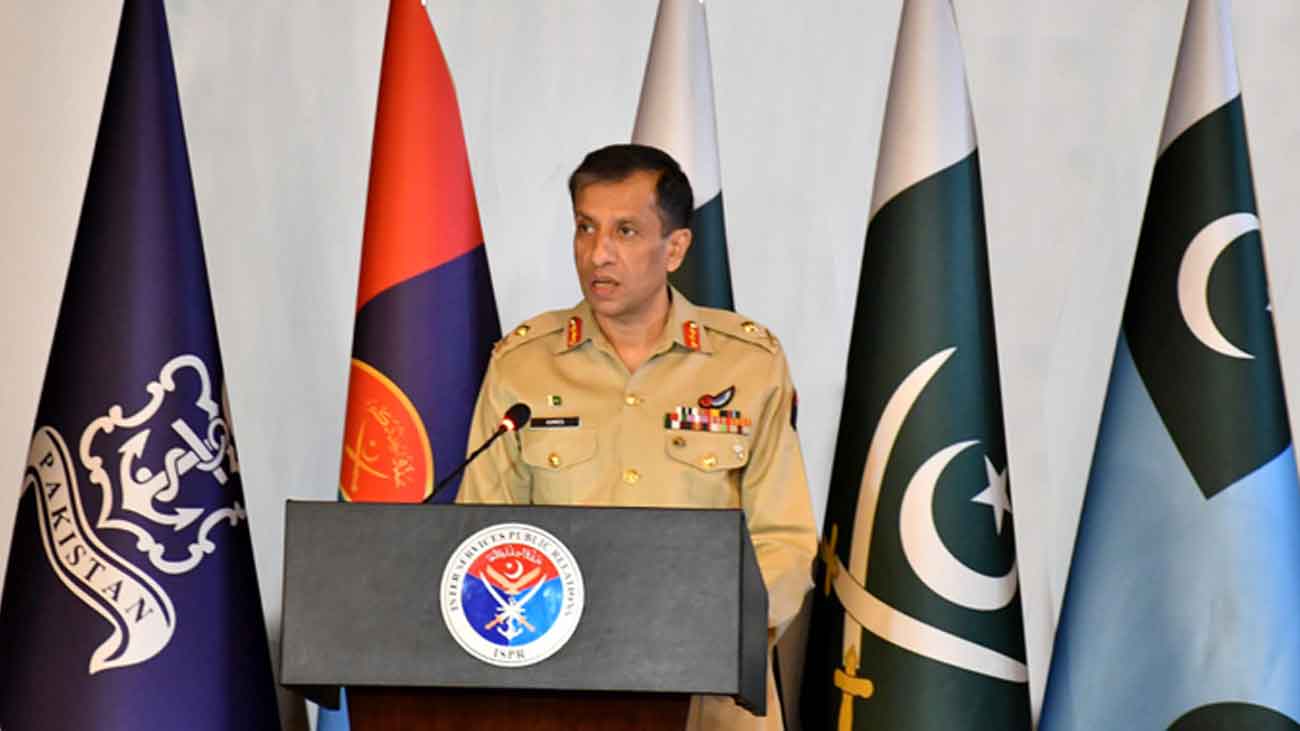
DGISPR Lieutenant General Ahmed Sharif Chaudhry firmly rejected India’s baseless accusations following the Pahalgam attack and presented concrete evidence of India’s involvement in state-sponsored cross-border terrorism, particularly in Balochistan.
In an important press conference, DG ISPR briefed the public on Pakistan’s security situation and addressed India’s allegations. He emphasized that even after seven days of the Pahalgam attack, India has failed to provide any credible evidence to support its claims against Pakistan.
Lieutenant General Ahmed Sharif Chaudhry stated that India continues to operate and support terrorist networks inside Pakistan. He disclosed that on April 25, security forces arrested a man named Abdul Majeed near Jhelum bus stand. Majeed, who had reportedly received training in India, was found in possession of a drone, an improvised explosive device (IED), and Rs. 25,000 in cash.
Read Also:DG ISPR Claims Indian Hand in Balochistan Terrorism After Jaffar Express Attack
At the United Nations, India’s Deputy Permanent Representative Yojna Patel labeled Pakistan as a “rogue state,” accusing it of fueling global terrorism. In response, the Pakistan Mission to the UN firmly rejected the allegation, stating that Pakistan possesses credible evidence proving that the recent Jaffer Express attack was externally sponsored by its regional adversaries. Pakistan emphasized that it remains a victim of cross-border terrorism rather than a perpetrator.
Tensions between Pakistan and India have intensified following these unfounded allegations. The Pahalgam attack in Indian Illegally Occupied Jammu and Kashmir (IIOJK) resulted in the death of 26 people, mostly tourists. India, without any investigation or proof, quickly blamed Pakistan for the incident. In response to the incident, India announced the suspension of the Indus Waters Treaty of 1960, closure of the Attari-Wagah borders, and withdrawal of travel privileges under the SAARC visa exemption scheme for Pakistani nationals. Furthermore, India decided to recall its defense attachés from Islamabad and reduce its diplomatic staff in New Delhi, asking Pakistani military advisors to leave within a week.
Pakistan, in a strong and measured reaction, rejected India’s decision regarding the Indus Waters Treaty and announced the closure of its airspace to Indian flights. These steps were finalized during a National Security Committee (NSC) meeting chaired by Prime Minister Shehbaz Sharif. The NSC discussed the prevailing regional situation, especially the fallout of the Pahalgam attack. It stressed that the Indus Waters Treaty is an internationally binding agreement, brokered by the World Bank, and cannot be unilaterally suspended.
NSC reiterated that water is a matter of vital national interest for Pakistan and essential for its 240 million citizens. It warned that any attempt to block or divert Pakistan’s rightful share of water would be seen as an act of war, prompting a comprehensive and forceful response across all domains of national power.