
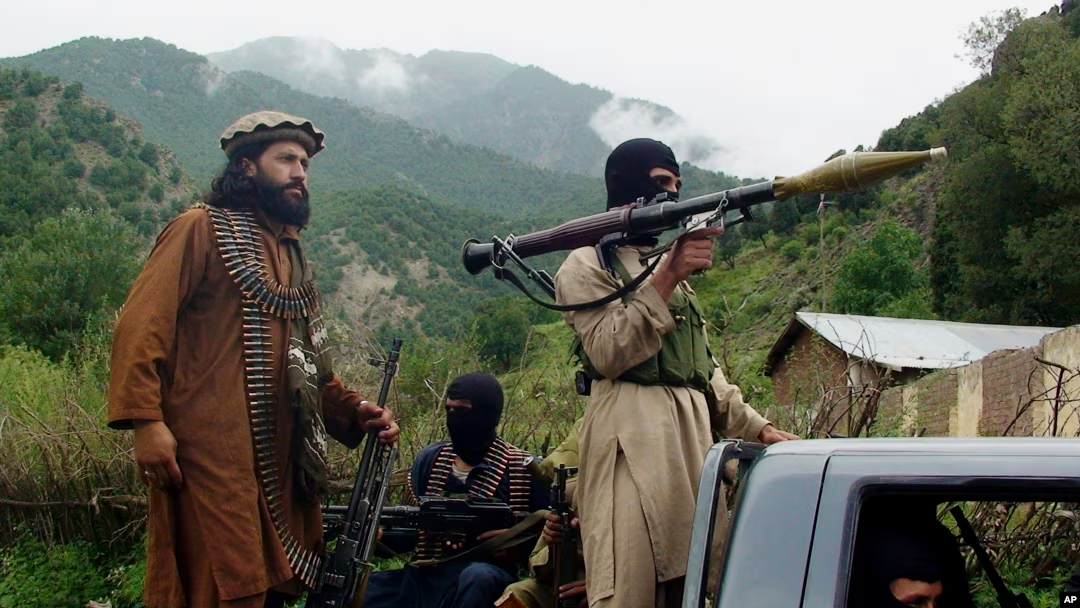
Recent developments in the global fight against terrorism have highlighted a worrying trend: the Tehreek-e-Taliban Pakistan (TTP), once predominantly a local insurgent group operating within Pakistan, has now evolved into a transnational terrorist platform. The pledge of allegiance by African Al-Qaeda-linked militants from Mali to TTP marks a pivotal moment in this transformation, confirming that the group is no longer limited to the South Asian region but is rapidly expanding its reach, threatening international security on a broader scale. This development raises serious concerns, as it signals a convergence of global extremist forces that could destabilize entire regions and undermine counterterrorism efforts globally.
Historically, the TTP’s activities were primarily confined to Pakistan, where it posed a severe threat to the government and civilian populations. However, over the years, the group has evolved into a more sophisticated and internationally connected entity, drawing recruits and support from various global jihadist movements. The recent involvement of African Al-Qaeda operatives, particularly from Mali, in the TTP’s network highlights this disturbing trend. These foreign elements are the latest in a series of fighters recruited from regions far beyond Pakistan’s borders, including militants from Bangladesh and Arab countries. The inclusion of African fighters signifies the growing transnational nature of the TTP, indicating that the group has successfully tapped into global terrorist networks and is operating as a platform for international jihadist collaboration.
The recruitment of African elements from Mali further underscores the ideological shift within the TTP. Once a group focused on regional grievances, the TTP has now embraced a broader global agenda. Its evolution mirrors the trajectory of past terrorist movements that initially started as localized entities but, over time, expanded their operations and affiliations, eventually becoming part of a transnational network. The TTP’s evolving ideology is emblematic of a wider trend within global terrorism, where local grievances are subsumed by a broader, pan-Islamic extremist ideology, fueling cross-border militant alliances. The involvement of Malian militants—who have long been linked to Al-Qaeda and other extremist groups in the Sahel region—suggests that the TTP has succeeded in transforming itself into a multinational terror organization with operations spanning multiple continents.
This transformation into a transnational terrorist group represents a shift in the TTP’s strategy. Previously, the TTP relied on a steady stream of domestic recruits and localized support for its operations. However, as it has increasingly relied on foreign fighters, it has exposed itself to a wider range of security challenges. These foreign recruits are often ideologically driven, coming from regions such as North Africa and the Middle East, and are typically willing to sacrifice their lives for the global jihadist cause. Their inclusion within the TTP highlights a significant shift: the group is no longer focused on its original objectives within Pakistan but is now aligning itself with a larger global extremist network.
The Mali pledge of allegiance is a telling indicator of the TTP’s deepening ties with Al-Qaeda remnants, as the organization continues to serve as a bridge between various international jihadist movements. This alliance is not just a formality; it reflects a deliberate attempt to reconstruct an international terror network with Pakistan as a key target in the broader global jihad. The expanding foreign footprint of the TTP is not just symbolic—it is an active strategy to reshape the region’s security dynamics, with Afghan sanctuaries playing a critical role in this transformation.
The sanctuaries in Afghanistan have long served as a breeding ground for global extremism. As the TTP increasingly recruits fighters from diverse regions, Afghanistan’s role as a convergence zone for international extremists becomes more pronounced. These sanctuaries, once primarily a haven for the Afghan Taliban, have evolved into a meeting place for jihadists from around the world, enabling them to coordinate, plan, and execute attacks on a global scale. The TTP’s ability to recruit and house foreign militants within Afghan territory underscores the importance of Afghanistan in the broader jihadist network, further highlighting the risk that this region poses to global security.
Read Also: TTP threatens Pakistan’s military-run businesses as violence rises
The inclusion of African extremists within the TTP also reveals the dangerous implications of unchecked terrorist sanctuaries. The Sahel region, where Mali is located, has long been a hotspot for terrorism, with groups like Al-Qaeda in the Islamic Maghreb (AQIM) and its affiliates operating across multiple countries. The growing involvement of African militants in the TTP’s network underscores the wider problem of porous borders and weak governance in regions where extremist groups can thrive. These environments, characterized by lawlessness and a lack of state control, create opportunities for terrorist groups to expand their reach and consolidate power.
Moreover, the TTP’s growing alliance with foreign terrorist elements reflects a broader shift in global terrorism. The group, which once operated with a local, regional agenda, is now increasingly aligned with international extremist interests. Its ideology no longer focuses solely on issues within Pakistan but instead embraces a global jihadist narrative. The TTP’s ability to attract foreign recruits is not just a testament to the strength of its ideology but also to the failure of regional governments to combat the spread of terrorism effectively. As foreign elements continue to join the TTP, it risks becoming a central node in the international terrorist network, with repercussions that could be felt far beyond South Asia.
The expansion of the TTP’s foreign network represents a growing security risk for both the region and the world. This shift from a localized insurgency to a transcontinental terror threat highlights the need for coordinated regional and international counterterrorism efforts. The international community must recognize that the TTP is no longer a purely Pakistani problem; it is a global issue that requires a unified response. Failure to address the TTP’s expanding foreign network risks allowing the group to mature into a global terror hub, similar to the conditions that once allowed Al-Qaeda to thrive in the late 1990s and early 2000s.