
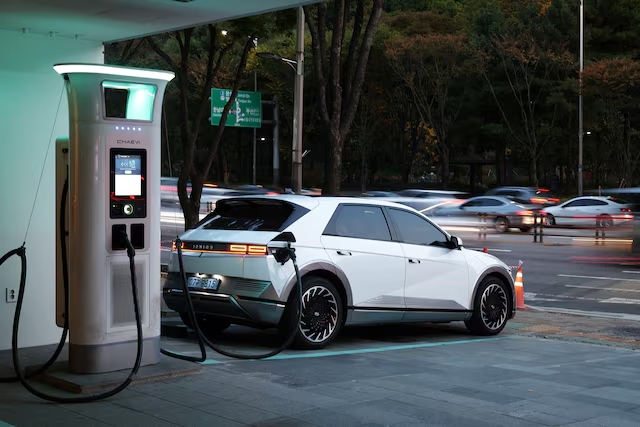
South Korea will significantly increase its electric-vehicle subsidies next year as part of a sweeping support package aimed at shielding its auto industry from the financial strain of steep U.S. tariffs. The government confirmed that EV subsidies will rise by roughly 20 percent in 2026, bringing the total allocation to about 936 billion won (around $658 million). The move is one of several measures designed to ensure the sector remains competitive at home and abroad amid an increasingly challenging global trade environment.
The announcement follows months of pressure on South Korean automakers, including Hyundai and Kia, which have been hit by a 25 percent tariff imposed by the United States on imported vehicles. The tariff has raised concerns about export volumes, profitability, and long-term market share in one of Korea’s most important automotive markets. Cars remain one of South Korea’s top export categories, accounting for more than 10 percent of national exports.
Government officials said the expanded EV subsidy program is intended not only to stimulate domestic demand but also to provide indirect relief to manufacturers facing higher export costs. By encouraging more Korean consumers to purchase electric vehicles, Seoul hopes to maintain production volumes, stabilize factory operations, and help automakers absorb tariff-related losses.
Beyond consumer subsidies, the government plans to increase policy financing for automotive parts suppliers surpassing the more than 15 trillion won already provided this year. Many suppliers are struggling to adapt to supply-chain disruptions, rising material costs, and the shift toward electric drivetrains. The financing will include low-interest credit lines, extended repayment schedules, and targeted support for companies investing in EV-related technologies.
Officials also outlined a strengthened guarantee system for Korean auto-parts companies operating in the United States and Mexico. These guarantees are intended to help firms access long-term, low-cost loans, upgrade facilities, and cope with fluctuating tariffs or potential regulatory changes in the U.S. manufacturing landscape. Industry experts say the initiative may encourage more suppliers to localize operations in North America, where Korean automakers are already investing heavily in EV and battery plants.
The new measures come after Seoul approved a separate 2 trillion won emergency fund earlier this year to offset the immediate shock of U.S. tariffs. That package included temporary tax cuts for car buyers, incentives for domestically produced EVs, and support for companies updating supply chains to comply with international rules.
South Korean policymakers say the auto industry is at a critical juncture. Global competition in the EV sector is intensifying as China expands aggressively into foreign markets and Western countries tighten subsidy rules. Meanwhile, several governments including the U.S. and members of the European Union are imposing new tariffs to protect local industries from cheaper imports. For Korea, whose export-driven economy depends on maintaining access to foreign markets, the pressure to adapt is mounting.
Industry analysts warn that sustained tariff pressure from the U.S. could reshape export patterns. While the American market remains vital, Korean carmakers are increasingly exploring alternatives in Southeast Asia, the Middle East, and Europe. The expansion of domestic subsidies allows manufacturers to stabilize revenue even as global conditions shift.
Hyundai and Kia have so far responded cautiously, welcoming the government’s support while reaffirming their commitment to North American production. Both companies are ramping up investment in U.S. EV and battery factories, viewing local manufacturing as the most effective long-term strategy for navigating trade barriers. In 2026, Hyundai Motor Group is set to open one of its largest EV production hubs in Georgia, which is expected to significantly expand its access to U.S. federal tax credits.
Despite the new subsidies, concerns remain about whether the support will be enough to protect small and mid-sized suppliers , many of whom operate on thin margins and have limited flexibility to absorb sudden cost shocks. Economists argue that Korea may need to take additional steps, such as tax reforms and expanded R&D funding, to help the industry achieve long-term resilience.
For now, the government says it is prepared to intervene further if tariff pressures intensify. “Our priority is to safeguard the competitiveness of Korean automakers and ensure that workers, suppliers, and consumers are protected,” an industry ministry official said. “We will continue to monitor global trade developments and respond swiftly as needed.”
South Korea’s decision to increase EV subsidies marks a strategic pivot at a time when global automotive markets are being reshaped by geopolitics, technological shifts, and fierce international competition. As Korean carmakers face a turbulent year ahead, Seoul’s financial support may prove crucial in helping the industry weather the storm and maintain its standing as one of the world’s leading automotive producers.