
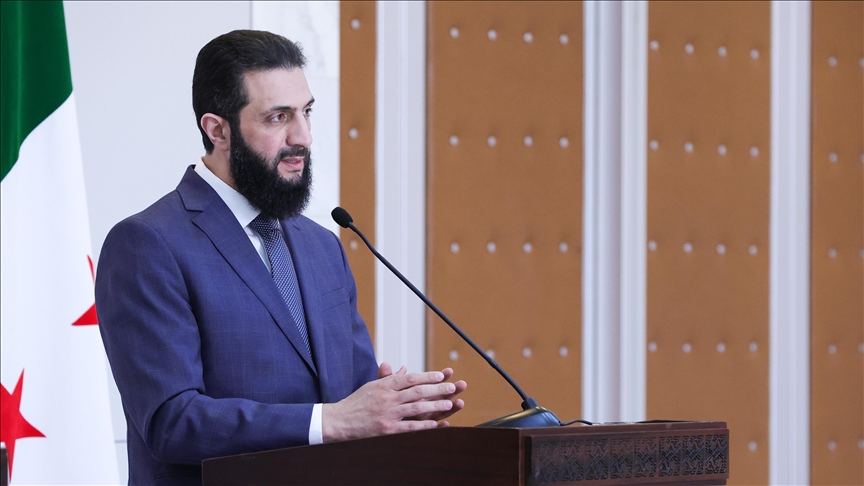
Syrian President Ahmed al-Sharaa made a joke at his former rebel base when more than 100 of his loyalists showed up in luxury SUVs, saying, “I didn’t know the salaries the government pays were this high!”
Sharaa scolded the assembled officials and business figures, asking, “Have you forgotten you are the sons of the revolution?” according to two people present. He pointed to the many Cadillac Escalades, Range Rovers, and Chevrolet Tahoes outside and added, “Have you been tempted so quickly?”
In the 10 months since overthrowing President Bashar al-Assad and ending 14 years of civil war, Syria’s former militant commander turned ruler has faced a turbulent period. The country has seen intermittent sectarian clashes involving ex-rebel groups now aligned with his government, resulting in over 2,000 deaths, along with a wave of forced evictions and property confiscations.
The previously unreported August 30 meeting was held at Sharaa’s former base in Idlib province, northwestern Syria, well away from his official presidential offices in Damascus. During the meeting, the former al-Qaeda commander was accompanied by two top security officials. According to two attendees and two civil servants briefed on the speech, Sharaa instructed government employees driving luxury cars to surrender their keys or face investigations for possible illicit enrichment. Some officials reportedly complied, handing over their keys as the meeting concluded, the attendees told Reuters.
Analysts and Syrian officials say the directive underscores a major challenge for the 43-year-old president: transitioning from insurgent leader to head of a civilian government without repeating the entrenched corruption that defined Assad’s authoritarian rule. What’s at stake is the legitimacy Sharaa has earned both at home and internationally by toppling the former dictator. “Sharaa has no institutional foundation or guiding framework to depend on,” said Hossam Jazmati, a Syrian expert on Islamist movements who has researched the former warrior-sheikh for over a decade.
“He’s the product of a faction, not a state institution,” Jazmati said. “Since 2003, he has functioned within a militia-style system where power depended on alliances, favoritism, and control.” Jazmati added that loyalists enriching themselves through war spoils could undermine Sharaa’s efforts to consolidate power. “He needs significant financial resources to keep his administration running not for personal enrichment, but to preserve his authority,” he said.
Syria’s Ministry of Information told Reuters that Sharaa convened an “informal, friendly gathering” in Idlib with former commanders, officials, and other prominent figures to discuss political and security issues, as well as the need to reform the “investment culture left by the previous regime.” “He emphasized that he would not tolerate any hint of corruption among government employees,” the ministry added.
Family Divisions and Power Consolidation
Sharaa’s efforts to balance power extend into his own family. Two of his older brothers hold senior roles in the new government: Hazem oversees business and investment, while Maher, a gynaecologist a Syrian-Russian dual national, serves as secretary-general of the presidency and accompanies Sharaa in meetings with foreign leaders, including Russian President Vladimir Putin in Moscow last month. Officials say the president’s reliance on relatives and close associates stems from the need to quickly fill administrative gaps after Assad’s sudden downfall, though critics warn it mirrors the nepotism of the previous regime.
A third brother, Jamal, has reportedly been caught up in Sharaa’s anti-corruption drive. According to multiple officials and business figures, Jamal opened an office in Damascus after Sharaa took power, running ventures in trade and tourism and leveraging his family ties to secure meetings with officials. In August, Sharaa ordered the office closed and barred state institutions from working with him. A Reuters visit confirmed the office was sealed with red wax a common sign of corruption probes.
The Information Ministry confirmed the closure, stating Jamal had no authorization to operate commercially and held no official position, though it did not specify any charges. Shortly afterward, Sharaa convened his family, including his father, to warn them against exploiting the family name. Jamal denied all allegations, saying he had no office or business dealings and that claims to the contrary were fabrications.
Corruption Complaints and Enforcement
Sharaa’s August warning to officials followed public complaints about the lavish lifestyles of former rebels now in government posts. In subsequent speeches, including one on October 13, he reiterated his anti-corruption stance, ordering officials to disclose investments, avoid private ventures, and distance themselves from businessmen to prevent a repeat of Assad-era graft.
Despite these pledges, corruption remains widespread. Nine businesspeople and current or former officials told Reuters that bribes are still paid to secure detainee releases, recover seized assets, or keep businesses running. One industrialist said he paid $100,000 to free an employee then was asked for another $100,000 for the worker’s reinstatement while another reported paying $25,000 for a similar release. The Information Ministry said such incidents were isolated and that suspects had been referred for investigation.
Asset Seizures and Oversight
A major concern among Syrian business circles is the opaque settlement system for those accused of links to Assad’s regime. Under these arrangements, business owners surrender assets in exchange for permission to resume operations. Authorities have directed these deals through a committee on illicit gains and a newly created sovereign wealth fund, which now holds hundreds of confiscated companies, factories, and properties. However, both bodies have faced scrutiny: two lawyers for the fund were arrested over alleged theft, and members of the illicit gains committee are also under investigation for suspected misconduct, according to officials. The ministry confirmed the arrests, noting the cases remain under review.