
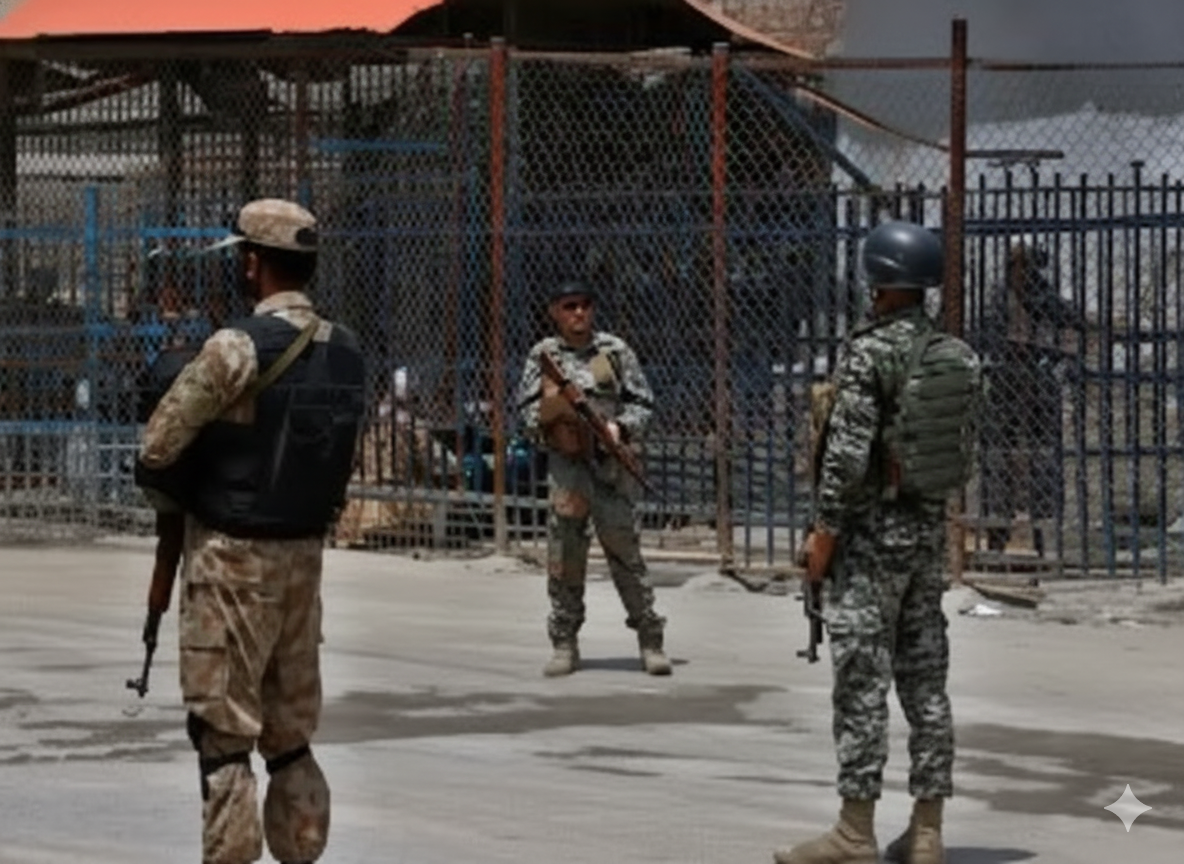
At least 23 Pakistani soldiers lost their lives and around 200 Taliban militants and allied fighters were killed in cross-border clashes triggered by an attack from the Afghan side, according to a statement issued by the Inter-Services Public Relations (ISPR) on Sunday.
The ISPR said the overnight clashes began on the night of October 11-12, 2025, when members of the Afghan Taliban and what it called India-backed Fitna-al-Khawarij launched an unprovoked assault along the Pakistan-Afghanistan border.
The Pakistani state uses the term Fitna-al-Khawarij to describe militants from the outlawed Tehreek-i-Taliban Pakistan (TTP), while groups operating in Balochistan are labeled under the term Fitna-al-Hindustan. In the overnight engagement, 23 Pakistani troops were martyred and 29 others wounded while defending national sovereignty. The ISPR stated that intelligence assessments indicate over 200 Taliban and allied insurgents were killed, with many more believed to be injured.
Kabul has justified its actions as a retaliatory response to alleged Pakistani air strikes on Afghan soil earlier in the week claims Islamabad has neither confirmed nor denied. However, Pakistan insists that Afghanistan must stop providing sanctuary to the TTP. Despite Pakistan’s repeated demands, the Afghan government continues to reject accusations that it allows terrorist groups to operate from within its territory for attacks against Pakistan.
ISPR condemned the Afghan military’s overnight aggression, characterized by gunfire and cross-border incursions, as a cowardly attempt to destabilize border regions and promote terrorist agendas. A late-night report by Radio Pakistan, citing security officials, said Afghan forces initiated unprovoked gunfire at several points along the border, including Angoor Adda, Bajaur, Kurram, Dir, Chitral (KP), and Bahram Chah (Balochistan).
Pakistan’s military, exercising its right to self-defense, forcefully repelled the attack across the entire border and inflicted significant losses on Taliban militants and their affiliates, according to ISPR. Targeted strikes and tactical raids were carried out against Taliban posts, training camps, and support networks based in Afghanistan, including elements associated with Fitna-al-Khawarij, Fitna-al-Hindustan, and ISIS-K/Daesh.
The military emphasized that every effort was made to prevent civilian casualties and avoid collateral damage during the operation. ISPR reported that numerous Taliban positions along the border were successfully destroyed through continued military action. According to ISPR, Pakistani forces temporarily seized 21 enemy positions across the Afghan border and disabled several training camps used for launching attacks into Pakistan.
Significant infrastructure damage was inflicted on Taliban camps, command centers, and logistical networks, with the impact extending from frontline positions to deeper operational zones. Pakistan’s armed forces reaffirmed their commitment to defending the nation’s borders and protecting its citizens, vowing to decisively confront any threats to national security.
While advocating for diplomatic and peaceful solutions, ISPR made it clear that Pakistan will not accept the hostile use of Afghan territory to conduct terrorist activities against it. The ISPR also pointed out the timing of the attack, noting with concern that it coincided with the Afghan foreign minister’s visit to India, which Pakistan accuses of being the region’s primary sponsor of terrorism.
For the sake of regional peace, ISPR urged the Taliban administration to take urgent and verifiable steps to dismantle terrorist groups like Fitna-al-Khawarij, Fitna-al-Hindustan, and ISKP/Daesh that are active within Afghanistan. It warned that if the Taliban government fails to act, Pakistan will maintain its right to defend its citizens by continuing operations against terrorist threats.
ISPR advised the Taliban regime to abandon aggressive posturing and instead focus on ensuring peace, stability, and progress for the Afghan people.
Pakistan Army Carries Out Strikes on Key Afghan Taliban Camps, Inflicts Heavy Losses:
PTV News earlier reported that the Pakistan Army had successfully carried out strikes on several Afghan positions, including Durrani Camp, Manojba Battalion Headquarters, Manojba Camp-2, and Ghaznali HQ in the Noshki sector, effectively neutralising all these sites.
The report further stated that dozens of Taliban fighters and Khawarij militants stationed at the targeted camps and headquarters were reportedly killed. Security officials revealed that the Pakistan Army also destroyed the Asmatullah Karar Camp in Spin Boldak, which they described as one of the Taliban’s largest and most critical bases used for launching attacks against Pakistan.
Reports indicate that the Taliban and Khawarij militants hiding in the camp sustained significant casualties during the strike. Radio Pakistan later released footage showing a second round of strikes that led to further destruction of the Asmatullah Karar camp in Spin Boldak.
Sources also reported that the Taliban’s second Battalion Headquarters in Brabcha, allegedly used to deploy Khawarij and Fitna-al-Hindustan militants into Pakistan, was targeted in the operation. PTV News, via multiple posts on X, confirmed that the Barikot base camp, Manojba Camp-3, Karzai post, and Shapola Khula post were among the additional Taliban positions destroyed by Pakistani forces.
Radio Pakistan reported that Pakistani troops captured a key Afghan post in the Zhob sector and raised the national flag. A Taliban Humvee stationed at the post was also destroyed during the operation. State media, citing security officials, stated that Pakistani forces destroyed multiple Taliban tanks positioned on mountain peaks across from the Kurram region.
State media, citing security officials, stated that Pakistani forces destroyed multiple Taliban tanks positioned on mountain peaks across from the Kurram region. An earlier report by Radio Pakistan quoted security sources saying that Jandusar Post, Turkmenzai Camp, and Kharchar Fort in Afghanistan were completely demolished by Pakistani strikes.
Conversely, a senior official reported that Afghan forces launched heavy, indiscriminate gunfire on Pakistani border posts in the Baramcha area of Chagai district, which borders Helmand province, late Saturday night. Security sources confirmed that Afghan troops attempted to breach the border into Pishin and Zhob districts, but their infiltration efforts were successfully repelled by Pakistani forces.
Afghanistan urges Pakistan to refrain from military action:
After the recent border clashes, Afghan government spokesperson Zabihullah Mujahid called on Pakistan to refrain from using military force, warning that such actions could lead to serious repercussions. Speaking at a press briefing in Kabul, Mujahid claimed that some factions within Pakistan’s security forces were attempting to create instability in Afghanistan.
He cautioned that Afghanistan has the military capability to retaliate if needed, but stressed that the Islamic Emirate had been trying to resolve its disputes with Pakistan through dialogue. The Afghan military earlier issued a statement saying that eastern Taliban border units were engaged in intense fighting with Pakistani forces in several areas, in response to alleged air strikes by Pakistan. Officials from Taliban-controlled provinces along the Pakistan-Afghanistan border including Kunar, Nangarhar, Paktika, Khost, and Helmand confirmed the ongoing clashes. Afghanistan’s Ministry of Defence also acknowledged that its forces had carried out retaliatory strikes against Pakistani security units during the night.
The ministry’s statement said the operations concluded by midnight, but warned that if Pakistan breached Afghan territory again, their forces were prepared to respond with strength. According to Reuters, Kabul announced on Sunday that it had ceased its attacks following requests from Qatar and Saudi Arabia. Residents on the Pakistani side reported that the Torkham border crossing was shut down for all types of movement following heavy overnight gunfire at multiple points.
Afghan official Qureshi Badloon, speaking from Nangarhar, also verified to Dawn.com that the Torkham crossing had been closed. In a separate report, Reuters quoted local officials who confirmed that two major crossings Torkham and Chaman along with three smaller ones at Kharlachi, Angoor Adda, and Ghulam Khan, were all closed on Sunday.
Pakistan will not tolerate any breach of its sovereignty:
As fresh reports of the clashes surfaced, President Asif Ali Zardari and Prime Minister Shehbaz Sharif both made clear that Pakistan would not make any concessions regarding its national sovereignty. In his statement, President Zardari referenced UN reports that confirmed terrorist attacks had originated from Afghan territory. Still, he emphasised that mutual respect and collaborative counter-terrorism strategies were essential for lasting peace in the region.
Reiterating Pakistan’s firm stance, Zardari stated that the country is fully committed to protecting its national interests, territorial sovereignty, and overall security. Zardari pointed out that multiple UNSC monitoring reports confirm that India-backed Khawarij terrorists have carried out attacks from Afghan territory controlled by the interim Taliban government. He further stated that Pakistan has consistently highlighted how Indian-backed Khawarij and allied terror groups are targeting Pakistani civilians and forces. Zardari called on the Afghan interim authorities to take firm and verifiable steps against these groups, describing Indian-sponsored terrorism as the region’s biggest threat to peace and stability.
Zardari remarked that terrorism is a collective issue that no single nation can shoulder alone. He also criticised the Afghan interim administration for abandoning support for the people of Indian-occupied Kashmir, calling it a betrayal of both history and the broader Muslim community. The president reiterated that Pakistan will reject any inaccurate or disputed claims regarding Jammu and Kashmir and reaffirmed that India’s position contradicts international law and United Nations Security Council resolutions.
Zardari also mentioned that Pakistan’s decades-long support for millions of Afghan refugees was a reflection of Islamic brotherhood and exemplary neighbourly relations. He stressed that the respectful return of Afghan nationals to their homeland is necessary for lasting peace and serves the interests of both nations. The statement added that while Pakistan remains committed to supporting Afghan people in education and humanitarian matters, it will never sacrifice its sovereignty.
Zardari highlighted Pakistan’s extensive efforts to promote trade, regional connectivity, and people-to-people relations with Afghanistan, stating that such cooperation is key to enduring peace and prosperity. He stressed Pakistan’s aspiration for a peaceful and prosperous Afghanistan and called for ties based on mutual respect, coordinated security efforts, and joint efforts to maintain regional stability. Zardari expressed optimism that the Afghan interim regime would prevent groups like the Khawarij and India-sponsored militants from operating against Pakistan, saying true peace requires collaborative and practical action. Prime Minister Shehbaz Sharif also denounced what he called Afghanistan’s provocative actions near Pakistan’s border regions.
He declared that Pakistan’s defence is non-negotiable and promised a firm and effective reply to any aggression. Sharif praised the professionalism of Pakistan’s military and commended their decisive response to the Afghan attack. He added that under Field Marshal Asim Munir’s leadership, the army not only retaliated forcefully but also dismantled multiple Afghan posts, forcing a withdrawal. He affirmed the military’s ability to defend the nation and highlighted their history of strong responses to external threats.
Sharif noted that Pakistan had frequently shared intelligence with Afghanistan about groups like Fitna-al-Khawarij and Fitna-al-Hindustan that are launching attacks from Afghan territory. He alleged that some factions within Afghanistan support terrorist outfits and expressed hope that the interim government would prevent these groups from using Afghan soil to target Pakistan. Interior Minister Mohsin Naqvi, in one of the earliest official comments, praised the armed forces for their swift and effective retaliation. He stated that “Afghan forces firing on civilian populations constitutes a blatant breach of international law.” Naqvi added that Pakistan’s forces had given an immediate and forceful response, underscoring that “no provocation will be tolerated.”
“Pakistan’s forces are fully alert, and Afghanistan is being answered with stones for bricks. The people of Pakistan stand united with their brave military like a solid wall. Afghanistan will face the same fitting reply that India has,” Naqvi posted on X. Deputy Prime Minister Ishaq Dar, voicing “serious concern” over the attacks from the Afghan side, said that “unprovoked firing and cross-border raids by Taliban forces constitute a grave provocation.” He explained that Pakistan’s “measured and proportionate response” targeted Taliban infrastructure and aimed to eliminate “Fitna-al-Khawarij” and “Fitna-al-Hindustan” terrorist networks operating from Afghan soil. Dar clarified that Pakistan’s counterattacks were defensive in nature and “not aimed at peaceful Afghan civilians.” He emphasized that, unlike the Taliban forces, Pakistan was exercising “maximum restraint” to prevent civilian casualties.
He further urged the Afghan interim authorities to take “decisive action” against terrorist groups and their sponsors who seek to disrupt Pak-Afghan ties. Dar assured that “Pakistan will adopt every necessary measure to safeguard its land, sovereignty, and citizens.” Former foreign minister and PPP chairman Bilawal Bhutto-Zardari also urged Afghan authorities to act “responsibly and with restraint” for the sake of regional peace. He warned that “unprovoked aggression” by Afghan forces along the border posed a “grave danger to regional peace and stability” and could undermine ongoing efforts for collective prosperity. Bilawal praised Pakistan’s armed forces for responding with “determination, restraint, and professionalism,” reflecting the country’s enduring dedication to peace and stability while protecting its borders and civilians.
He also called on the Taliban government in Kabul to take “clear and verifiable steps” against militant groups operating from its territory, cautioning that such organizations threaten not only Pakistan but the entire region’s security and future. Bilawal reiterated that Pakistan seeks a “peaceful, stable, and thriving Afghanistan,” urging Taliban leaders to engage in “practical, result-driven dialogue and cooperation” to achieve lasting peace and stability in the shared region. He concluded by expressing hope that the Afghan interim authorities would prevent their soil from being used against Pakistan and that both countries would move forward together, guided by mutual respect, peace, and regional prosperity.
Regional Powers Urge Calm Amid Pakistan-Afghanistan Border Tensions:
After reports of border clashes emerged, several countries called on Pakistan and Afghanistan to act with restraint and avoid any escalation. Saudi Arabia which recently signed a mutual defence agreement with Pakistan expressed concern over the ongoing skirmishes between the two neighboring countries. In an official statement, the Kingdom urged both sides to exercise restraint, refrain from actions that could worsen the situation, and instead adopt dialogue and wisdom to ease tensions and preserve regional peace and stability.
It also reaffirmed its support for all regional and international initiatives aimed at promoting peace and security, reiterating its continued commitment to ensuring stability and prosperity for the “brotherly peoples” of Pakistan and Afghanistan. Similarly, Iran’s top diplomat, Abbas Araghchi, appealed to both nations to show restraint amid the ongoing clashes, saying in a live interview on state television that both sides must act responsibly and avoid escalation, as stability between Pakistan and Afghanistan contributes to broader regional stability.
Qatar’s foreign ministry also joined the international calls for calm, urging both countries to prioritize dialogue, diplomacy, and restraint. It encouraged Islamabad and Kabul to address their differences in ways that help reduce tensions and prevent further escalation, thereby supporting regional security and stability. Reaffirming its stance, Qatar reiterated its backing for all regional and international efforts dedicated to promoting peace and stability and pledged its continued commitment to ensuring security and prosperity for the people of both nations.