
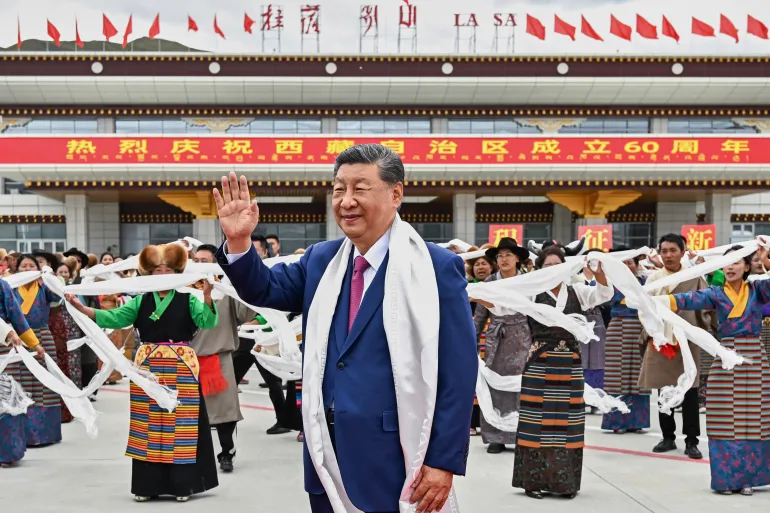
On August 21st, The Chinese President Xi Jinping made an announced visit to the city of Lhasa, in Tibet marking the 60th Anniversary of the region’s designation as an autonomous area. The ceremony consisted of various parades, dances and the adversity of Chinese communism through posters, banners, and other festive arrangements, all praising the government of Xi.
While addressing at the event, Xi Jinping emphasized and stressed upon the importance of Political and social stability, ethnic unity and religious harmony, calling upon the Tibetan Buddhists to adopt socialist values.
He also talked about how ecological protection is crucial to present Tibet as a green shield for China’s environment, and urged for stronger promotion of Mandarin Chinese in schools and administration for Tibetan unification with the mainstream. Some officials reportedly also commented on the recent developments and modernization initiatives being carried out, including the infrastructure projects for highways and railways.
It is significant to notice that the Chinese president reassured that Tibet is a part of China and would always be a national matter, thus any sort of separatism or independence movement is considered a threat to the sovereignty of China, and is an approach to fragmenting the nation which Beijing never wishes for.
In response to the president’s remarks, various analysts have viewed Xi’s speech contradictory to the position of Dalai Lama who is Tibet’s highest spiritual figure, believed to be the reincarnation of Avalokiteśvara, the Bodhisattva of Compassion.
The current Dalai Lama, Tenzin Gyatso, born in 1935 was recognized as the leader at age two, who later fled to India after the 1959 uprising when the Tibetan revolt against Chinese rule broke out in March 1959 in Lhasa and was crushed by the army.
Even though Tenzin Gyatso gave up his political authority in 2011 and remains exiled, he is widely recognized as a spiritual Tibetan leader and a global peace icon, who advocates for dialogue and non violence.
Upon Tenzin Gyatso recently turning 90, the closed topic sparked into debate once again, this time around upon the succession of Dalai Lama and his reincarnation that only happens when the previous one dies as Tibetans firmly believe that each Dalai Lama is reborn, identified by visions, signs, and monastic recognition. However, according to the Chinese order, Beijing insists that the state has final authority over the process of succession and reincarnation for the Dalai Lama.
Fascinatingly, In a recent statement it was declared by the 14th and currently serving Dalai Lama that his successor will be likely chosen outside of China to prevent manipulation by the government, as previously in 1995, the Chinese government kidnapped the Dalai Lama’s chosen Panchen Lama and installed its own, showing how succession disputes are politicized.