
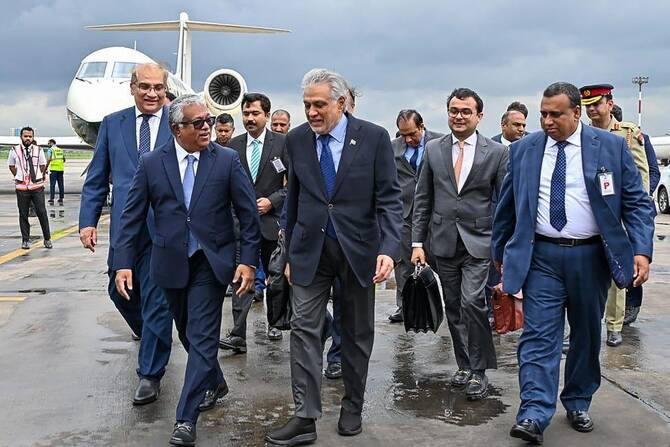
Deputy Prime Minister and Foreign Minister Ishaq Dar arrived in Dhaka on Saturday, marking the first official visit by a Pakistani foreign minister to Bangladesh in 13 years. The Foreign Office described the trip as a “significant milestone” in efforts to reset ties between the two South Asian neighbors.
High-Level Engagements in Dhaka
Upon his arrival, Dar was welcomed by Bangladesh’s Foreign Secretary Asad Alam Siam, Pakistan’s High Commissioner Imran Haider, and senior Bangladeshi officials. His two-day stay, from August 23 to 24, includes key meetings with Chief Adviser Professor Muhammad Yunus and Adviser for Foreign Affairs Touhid Hossain.
According to the Foreign Office, discussions will span the entire range of bilateral relations, covering trade, cultural cooperation, and regional issues. Both sides are expected to sign several agreements on trade and connectivity during the visit.
Advancing Bilateral Cooperation
The visit comes at a moment of renewed engagement between Islamabad and Dhaka. Relations began warming last year following the ouster of former prime minister Sheikh Hasina. Since then, the two countries have launched direct sea trade routes, expanded government-to-government commerce, and taken steps toward easing travel restrictions.
In April, Pakistan and Bangladesh resumed Foreign Secretary-level consultations after a 15-year pause, highlighting their commitment to dialogue. Moreover, last month both nations agreed to grant visa-free entry to holders of diplomatic and official passports, signaling a step toward smoother exchanges.
Building Economic Momentum
Dar’s visit follows the efforts of Pakistan’s Commerce Minister Jam Kamal Khan, who visited Dhaka earlier this week. During his meetings, both sides agreed to revive the Joint Economic Commission and establish a Joint Trade Commission to push investment, food security, and shipping collaboration.
Additionally, Pakistan delivered 50,000 tons of rice under a trade agreement in January 2025, and officials are exploring opportunities in agriculture, renewable energy, textiles, halal trade, and digital commerce. Business leaders in Chittagong also emphasized the need for direct air links and more efficient shipping routes.
Looking Toward a Forward-Looking Partnership
Speaking at the Pakistani High Commission in Dhaka, Dar underscored Islamabad’s commitment to a “cooperative and forward-looking relationship” with Bangladesh. He stressed that both countries share deep cultural, historical, and religious ties, and that the moment was ripe to move beyond differences and embrace mutual opportunities.
With trade agreements on the horizon and frequent high-level exchanges, officials believe this visit marks a turning point. The renewed momentum has the potential to strengthen political trust, economic partnerships, and people-to-people connections between the two nations.
As Islamabad and Dhaka look ahead, both sides appear determined to build a modern partnership rooted in shared prosperity, regional cooperation, and respect for each other’s sovereignty.