
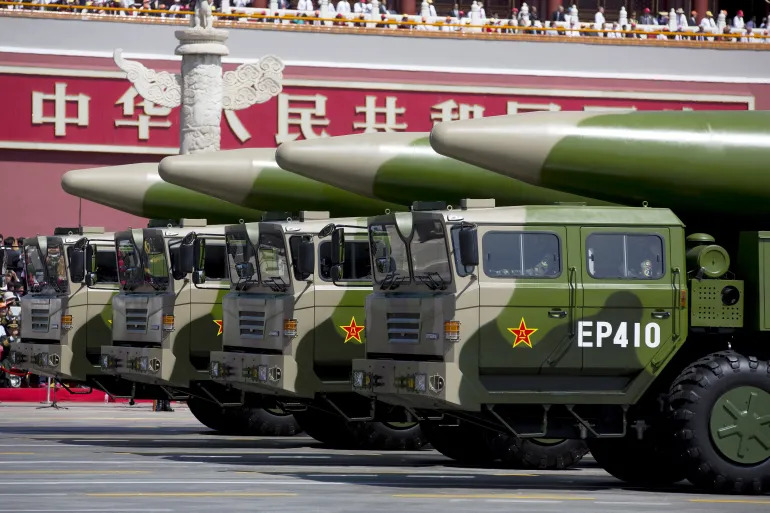
China will stage a vast “Victory Day” parade in Beijing on Sept. 3 to mark 80 years since Japan’s World War Two surrender, and military leaders say the event will put tens of thousands of troops and a raft of advanced weapons on public display including systems some analysts say have never before been shown to the world.
Organizers say the roughly 70-minute procession will include 45 troop formations, hundreds of aircraft and large numbers of ground vehicles and missiles organized into what the People’s Liberation Army calls “joint combat groups,” a presentation meant to show how China’s services operate together in modern warfare. President Xi Jinping is expected to inspect the parade in Tiananmen Square, and Russian President Vladimir Putin has been listed among invited dignitaries.
Military briefings and open-source imagery suggest Beijing will use the occasion to spotlight newly developed weaponry: experts name hypersonic strike systems, anti-ship missiles, carrier-based aircraft and drone-defeat technologies among the items likely to appear. Some of these assets have been deployed in recent tests but not previously paraded on such a public stage, prompting Western and regional security analysts to treat the event as both a commemoration and a strategic signal.
Preparations have been visible across the capital. Large-scale rehearsals under hot summer skies have seen rows of troops drilling in formation and vehicle columns moving into staging areas while authorities tighten security, divert traffic and temporarily close shopping and office districts ahead of the main event. Officials say these measures are standard for an event of this scale; independent reporters say the drills underscore the political as well as military importance Beijing attaches to the anniversary.
Analysts note two linked messages behind the parade: memory and might. On one level, the ceremony is framed as a tribute to China’s role in defeating Japanese militarism and a reaffirmation of national unity. On another, the public unveiling of sophisticated systems particularly long-range missiles and hypersonic capabilities functions as a clear demonstration of China’s growing ability to threaten offshore and distant targets, a fact that has fresh implications for neighbours and for U.S. planning in the Indo-Pacific.
Regional capitals and Western officials are watching closely. Some governments that attended or stayed away from the 2015 parade will be weighing attendance this year against concerns about China’s military messaging. Security specialists say the parade could shape strategic calculations in Seoul, Tokyo and Washington by lowering the uncertainty about Beijing’s force structure and doctrine even as it raises questions about intent.
Beijing insists the display is defensive in intent. State outlets and military spokespeople emphasize joint training, system integration and the modernization of equipment to protect territorial integrity. At the same time, the scope of the matériel on show and the speed at which China has modernised its forces over the past decade has led many outside experts to argue that doctrine, posture and capability are now changing in ways that deserve sustained international attention.
This will be China’s second major Victory Day parade since 2015 and comes as the country seeks to burnish its image as a rising global power while marking a symbolic historical milestone. Whether foreign leaders accept invitations, how many and which systems are paraded, and how Beijing stages the event will all be read for signals about China’s military ambitions and about the interplay between commemoration and coercion on the world stage.