
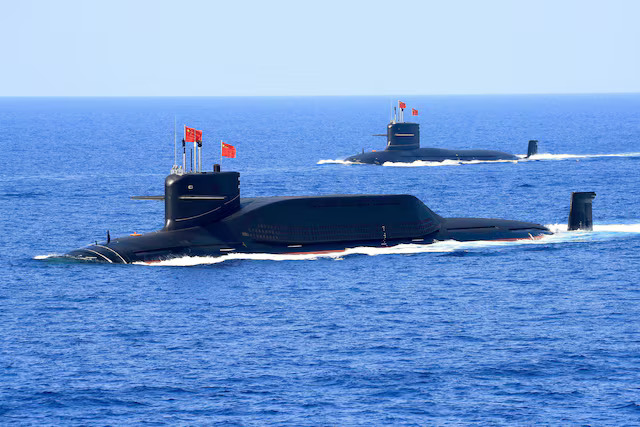
China is rapidly expanding and modernizing its nuclear forces, with multiple assessments showing Beijing now possesses roughly 600 warheads and is constructing hundreds of new missile silos and delivery systems. The pace of this buildup is altering global strategic balances and fuelling concerns about the potential for a new nuclear arms race.
According to the Pentagon, China’s operational stockpile surpassed 600 warheads by mid-2024 and could grow to around 1,000 by 2030 if current trends continue. Independent organizations, including the Stockholm International Peace Research Institute and the Federation of American Scientists, put the current number in the range of 500 to 600, with visible evidence of accelerated warhead production and infrastructure development.
Satellite imagery and open-source research confirm extensive construction of new missile fields. Analysts estimate China is building as many as 350 new silos alongside a growing fleet of mobile launchers, creating a larger, more dispersed arsenal that complicates adversaries’ defence planning. This diversification includes short-range tactical systems and long-range intercontinental ballistic missiles capable of striking the United States.
Experts warn that the rapid expansion undermines stability by reducing warning times, increasing the risk of miscalculation, and making arms-control verification more difficult. U.S. officials note that China’s growing long-range missile capacity strengthens its ability to hold distant targets at risk, raising security concerns for Washington and its allies in Asia. Observers in Seoul and Tokyo are already reassessing defence strategies in light of the shifting balance.While the exact numbers vary, most estimates rely on a combination of intelligence assessments and satellite monitoring, which converge on a significantly larger arsenal than previously assumed. Analysts highlight that many of China’s warheads may still be kept in storage rather than deployed, but the overall trajectory remains upward.
The expansion comes as arms-control frameworks weaken globally. Researchers caution that without renewed diplomatic engagement, the world risks sliding into a new era of nuclear competition. Proposals for confidence-building measures, such as data exchanges and limits on silo construction, have been floated, but their feasibility remains uncertain without strong political will.
Beijing insists that its buildup is defensive, reiterating its “no first use” nuclear policy. Western analysts counter that doctrine does not always match force posture, and the speed of the expansion leaves room for doubt. Some argue that China’s arsenal remains far smaller than those of the United States and Russia, while others warn that at the current pace the gap will narrow far sooner than expected.
The Pentagon projects China could approach 1,000 warheads by the end of the decade, a number that would place it firmly alongside other nuclear powers in terms of strategic capability. Whether the international community responds with diplomacy or competition will determine how this buildup shapes the future of global stability.