
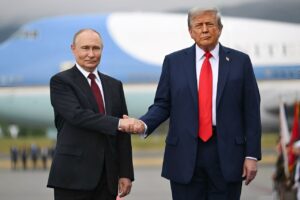
US President Donald Trump and Russian President Vladimir Putin met on August 15, 2025, in Alaska for a high-stakes summit focused on the ongoing war in Ukraine. The summit, held at Joint Base Elmendorf-Richardson in Anchorage, marked a rare direct engagement between the two leaders amidst soaring tensions and complex geopolitical dynamics.
Trump approached the talks with confidence, asserting that he believed Putin was convinced to strike a peace deal given their rapport and the mounting pressure from economic sanctions on Russia. He characterized the Alaska meeting as a preliminary step, or “listening exercise,” to gauge Putin’s ideas regarding peace and a possible ceasefire. Trump also indicated that this summit could pave the way for a larger trilateral meeting involving Ukrainian President Volodymyr Zelenskyy and possibly European leaders. This future summit would aim to finalize any peace agreement after more comprehensive discussions.
Despite Trump’s optimism, Zelenskyy publicly voiced strong concerns about being excluded from direct talks. He insisted that Ukraine must have a decisive seat at any negotiation table and categorically rejected any notion of territorial concessions or “land swaps” without Ukraine’s explicit consent. Zelenskyy emphasized that any peace deal formulated without Kyiv’s full involvement would be “dead.” These views were echoed by European leaders, who warned that any peace process must uphold Ukraine’s sovereignty and territorial integrity, with a ceasefire being a critical prerequisite before political or territorial changes are discussed.
Putin, en route to Alaska, was reported to have made symbolic visits to his country’s Far East, including a fish oil factory in Magadan, signaling a broader narrative of Russia’s resurgence on the global stage. Kremlin officials described Russia’s position as clear and firm ahead of the talks. The choice of Alaska as the venue carried historical symbolism, as the state was once a Russian possession sold to the United States in the 19th century. Russian media hailed the summit as a diplomatic victory and a sign of Russia’s return to global affairs, despite Western sanctions and isolation attempts.
The summit faced skepticism from international observers and analysts who viewed it less as a moment of immediate breakthrough and more as the opening of a longer, complex negotiation process. Some Ukrainian officials expressed fears that the summit could serve to shift blame for stalled peace efforts onto Ukraine if Trump and Putin pursued unilateral dealmaking. Simultaneously, American officials underscored that lasting peace would require extensive follow-up conversations and agreements beyond the initial encounter.
The meeting’s agenda reportedly included discussions on potential ceasefires, economic sanctions’ impact, and even the prospect of nuclear arms control talks. An idea floated ahead of the summit was an “air truce,” where both sides would halt airstrikes as a confidence-building measure, though the feasibility of such an agreement remained uncertain.
Amidst the summit preparations, the Eastern Ukraine battlefield saw intensified fighting, with Russian forces making gains in the Donetsk region and edging closer to strategic towns like Pokrovsk. Ukraine maintained its defensive resolve, with Zelenskyy affirming ongoing resistance and counter-pressure against Russian advances. These developments underscored the fragile and volatile context in which the Alaska talks took place.
Locally in Alaska, public reaction was mixed, with protests supporting Ukraine and opposing Putin’s visit occurring alongside expressions of pride in hosting a major diplomatic event on American soil.
Overall, the Alaska summit represented a critical but cautious step toward resolving the Ukraine conflict. Trump’s eagerness to leverage his relationship with Putin contrasted with persistent skepticism over the exclusion of Ukraine’s leadership from direct talks. The success of the summit would ultimately depend on careful follow-up engagement involving all key stakeholders, particularly Ukraine, to ensure any peace agreement respects sovereignty and provides a durable resolution to the conflict.