
In a major escalation of Serbia’s months-long anti-government protests, demonstrators on Aug. 14 attacked the local office of the ruling Serbian Progressive Party (SNS) in Novi Sad, the country’s northern second-largest city. Eyewitnesses said a group of protesters, encountering no police or party guards, smashed the building’s windows, dragged out desks, documents, and party paraphernalia, and painted the entrance. The crowd chanted that President Aleksandar Vučić’s 13-year rule was over as they carried out the vandalism. Reuters reported that the protesters “demolished the offices of the ruling SNS” in Novi Sad, ripping out furniture and removing party banners as they walked away. Police arrived afterward, cordoning off several blocks of the city centre and using tear gas to disperse the crowd.
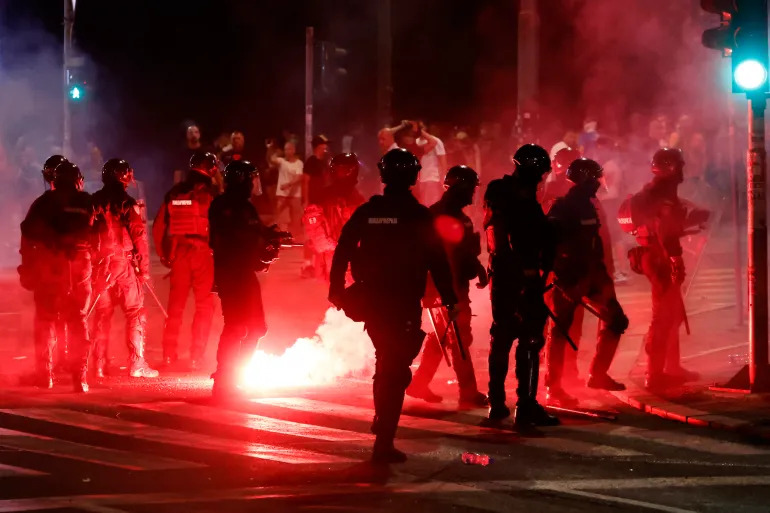
By nightfall, the unrest had spread. In the capital Belgrade, hundreds of anti-government demonstrators clashed with SNS loyalists on the main boulevards. Protesters and ruling-party supporters hurled flares and firecrackers at each other, and police in full riot gear again used tear gas to break up the skirmishes. Interior Minister Ivica Dačić said clashes had occurred in about 90 towns nationwide over two days, leaving dozens of people injured, including multiple police officers, and resulting in dozens of arrests. Reuters noted that by Thursday morning at least five police officers were hurt in Novi Sad alone.
The confrontations followed several nights of largely peaceful student-led protests. Thousands had gathered across Serbia demanding accountability for a fatal railway station accident and Vučić’s resignation, but Wednesday’s demonstrations turned violent in places, causing dozens of injuries and nearly 50 detentions, according to local media.
The attack on the SNS office in Novi Sad is rooted in public anger over last year’s infrastructure disaster. In November 2024 the roof of the renovated Novi Sad railway station collapsed, killing 16 people. That disaster, widely blamed on construction flaws and corruption, sparked student-led protests nationwide. Demonstrators have repeatedly demanded early parliamentary elections to unseat Vučić and his party, which has governed Serbia since 2012. Protesters have accused the government of cronyism, collusion with organized crime, violent repression of dissent, and curbs on media freedom. Vučić denies the allegations, but recent rallies have been marked by chants calling him a dictator and accusing the state of operating as a mafia state.
President Vučić responded to the violence by promising a tough crackdown. On state television, he declared “the state will win,” accused protesters of being directed by foreign enemies, and promised more arrests. Interior Minister Dačić also condemned the riots and said police would identify and sanction anyone who broke the law.
Opposition leaders rejected the government’s account. The Freedom and Justice Party reported that one of its MPs, Peđa Mitrović, was injured in the clashes and hospitalized. The party blamed the violence on the ruling SNS, calling the attack on its own offices a symptom of the government’s failure to address public grievances. EU enlargement commissioner Marija Gabriel said reports of violence were “deeply concerning” and urged that protests be allowed to proceed peacefully.
Vandalism of SNS offices was reported in other cities as well, including Niš and Kragujevac, where protesters removed party flags and posters. Regional media said anti-government rallies took place in Belgrade, Novi Sad, Niš, Kraljevo, Čačak, Šabac, Valjevo, and other cities, often centring on SNS premises. In several cases, police used tear gas to disperse crowds outside the buildings.
Protesters cite stagnating living standards, restrictions on media, and entrenched corruption as reasons for their anger. Many demand faster political reforms and closer alignment with the European Union, despite Vučić’s close ties with Russia and China. By late Thursday the demonstrations showed no signs of slowing. Students in Novi Sad pledged to continue daily rallies and a new protest camp was set up near the parliament in Belgrade. For many, the destruction of the Novi Sad SNS office symbolized how a single tragedy, the station collapse, has grown into the most serious anti-government movement in Serbia in years.